Pages

Showing posts with label lex orandi/credendi. Show all posts

Saturday, January 8, 2011

some Noel works


Noel Collins Pfeifer, Reviewer

Making Room: Recovering the tradition of Christian Hospitality
by Christine Pohl


Pohl begins with a historical excavation into the ancient Christian tradition of hospitality and finds it to be a quintessential part of the Church’s identity. The material is well-researched and well-presented. She gleans strength from her treatment of Scripture, tradition, reasoning a plausible re-shaping of it in contemporary culture and being shaped by the experience of historical and present day hospitality ministers. Pohl writes of hospitality as a deeply Biblical practice that God even forged into the Covenant with Israel through their “identity as aliens and related responsibility to sojourners and strangers.” (27) They even saw it as a place of sacramental meeting with God. Pohl is also critical of many aspects of today’s particularly Western context that have and may continue to impede hospitable churches and homes. These include fear, busyness, loss of a sense of Church as family and the valuing of individualism. However, Pohl has not lost hope and continues to explore the possibility of reconstituting hospitable attitudes and practice with the help of God and the wisdom of those who have previously taken up the mantle. No conversation on hospitality would be complete without defining “stranger”, the art of welcoming, the dignity of persons, the power of recognition, communal meals, multiple Church or family co-operation, and the importance of laughter. She also outlines many of the challenges inherent to this ministry and those nitty, gritty, honest fears and questions that may very well keep people from ever even attempting hospitality. Pohl does not pull punches or minimize the loss of this hallmarking tradition, but it is clear that she believes in an educational-conversational approach rather than simply making Christians feel guilty about it. She speaks as a prophet in, for and to the Church. Overall, it is a vastly helpful book for those who recognize that our society is truly yearning for belonging, and that the Church is in a unique position to offer genuine belonging and love through open hearts and open doors. It is a highly accessible read, enabling to the hospitable of heart and exhortative to those who are not gifted but consider hospitality a valuable tradition to be resuscitated in the Church. For further practical help, she includes some brief information from existing hospitality ministries worldwide and an extensive bibliography. Making Room is an important asset to this Biblical discipline’s rediscovery and incorporation, which Pohl would say, and I would agree, is paramount to the proclamation of the Gospel and the symbol of our eschatological hope of feasting together at the wedding banquet of the Lamb.

Monday, December 27, 2010

more incomplete works of greg


An essay prepared for the last section on Early Church History

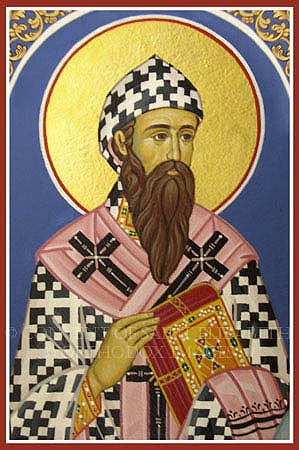
In his Third Epistle to Nestorius, Cyril of Alexandria argues against the writings and teachings of Nestorius concerning the nature of the person of Christ. Nestorius has propagated a Christology which drew a great distinction between the humanity of Christ and the divinity of Christ, the Eternal Word. Nestorius had been concerned about Apollonarianism and the claims that the humanity of Christ was subsumed by his divinity. Attempting to realign that error, and to protect the divinity of Christ which clearly could not change, suffer or die, Nestorius ended up splitting the two natures of Christ dividing Christ's words and acts between his humanity and divinity, respectively. Cyril's approach to argue against Nestorian Christology relies on a three-fold system of “rules” used in early ecumenical counsels for reaching theological decisions: Do not contradict Scripture; Do not threaten the means of salvation through Christ; And do not interfere with the liturgy.
Cyril regularly appeals to Scripture in order to disprove Nestorius showing him how he has misused Scripture and departed from the correct interpretation thereof. Cyril urges Nestorius to “abstain from these mischievous and distorted dogmas, which you hold arid teach, and to receive the right faith, handed down to the churches from the beginning through the holy Apostles and Evangelists, who 'were eye-witnesses, and ministers of the Word'” (Third Epistle to Nestorius, 1). It is evident that there is an essential connection between Scripture and the faithful interpretation of Scripture as passed down through tradition, or “right faith”. Cyril also quotes and references Scripture in order to build up his case for the unity of the two natures of Christ and the necessity that He be both fully God and fully human in all his words and actions.
Cyril appeals to the second of the unofficial “rules”, when he argues that Nestorius is threatening salvation through Christ. It is necessary for salvation that the Eternal Word died on the cross in unity with Jesus' humanity, “in order that, having trodden down death by his unspeakable power, first in his own flesh...and that he might make a way for the nature of man to attain incorruption” (Third Ep, 3).
Lastly, Cyril protects the liturgy, specifically the sacrament of the Eucharist, from the Christology of Nestorius. Cyril argues that Nestorius has divided Christ into two, separating the humanity and divinity in such a way that he cannot be rightly worshiped in Unity, but is rather two different objects of worship where believers must somehow render praise to Jesus the man as well as Christ the God. Cyril uses the practice of the Eucharist to uphold the indivisible union of the two natures of Christ in one person. If the person of Christ is divided, then he is not present in the Eucharist and those who partake of it do not partake in the life-giving Word who died. This argument asks the question, “was not the Eucharist a re-enactment of the miracle of Bethlehem, at which the life-giving Body and Blood of Christ were offered to be received by the faithful?” (Chadwick, 198).
This process carries validity to how we may do theology today, but the diversity of Orthodox Christian practice may cause difficulties to use this approach with consistency. To uphold Scripture as paramount and to defend salvation through Christ are certainly necessary and Christianity remains in agreement on these points. Arguing from liturgy provides more difficulties, especially with perennial debates concerning the nature of the Eucharist, or Lord's Supper and Baptism. A more robust theology of liturgy across all Christian denominations would enliven theological debate, especially since lex orandi lex credendi is alive and well in the 21st century.